
Harjaap Mann

Mississauga employer reviewing independent contractor agreements with an employment lawyer.

Independent Contractor or Employee? The 2026 Misclassification Risk for Mississauga Employers

Independent Contractor or Employee? The 2026 Misclassification Risk for Mississauga Employers Not Legal Advice This article is general legal information provided by Mann Law and does not constitute legal advice. Reading it does not create a solicitor-client relationship. Every corporate and tax situation is different — speak with a licensed Ontario lawyer and your accountant about your specific circumstances before acting on anything discussed here. Two separate tests, same worker When a Mississauga business engages a worker as an “independent contractor,” two entirely separate legal tests can be applied later — often at very different times — to challenge the classification. The CRA test. The Canada Revenue Agency applies a two-step framework, described in publication RC4110, to determine whether a worker is an employee or self-employed for tax, CPP, and EI purposes. The first step asks what the parties intended when they entered the arrangement; the second step examines the substance of the relationship across several factors, including control, tools and equipment, chance of profit and risk of loss, integration into the business, and the ability to subcontract or hire helpers. The ESA test. Ontario’s Employment Standards Act, 2000 establishes minimum standards for employees — hours of work, overtime, public holidays, vacation, and termination pay. Section 5.1 of the ESA prohibits treating an employee as if they were not one; the ESA definition of “employee” is broad and looks at the actual working relationship, not the label used in the agreement. A third framework — the common-law test applied by Ontario courts — determines whether a worker is entitled to reasonable notice of termination, and can also produce a hybrid category called “dependent contractor” that carries entitlement to notice even without full employee status. The factors that actually matter The CRA’s two-step process asks first about the parties’ intent, then examines the substance of the relationship across several factors. The Supreme Court of Canada in 671122 Ontario Ltd. v. Sagaz Industries Canada Inc., 2001 SCC 59, framed the same inquiry as a single central question: whether the person who has been engaged to perform the services is performing them as a person in business on their own account. Justice Major noted that the list of relevant factors — control, ownership of tools, chance of profit, and risk of loss — is non-exhaustive, and that the relative weight of each factor depends on the particular facts. In practice, the factors that most often decide the question in an SME context are: Who decides when, where, and how the work is done? Employees are told; contractors decide. Fixed daily schedules, mandatory meetings, and dress-code requirements point strongly toward employment. Tools and equipment. Who provides the laptop, phone, software, vehicle, and workspace? A worker who uses the payer’s equipment full-time looks more like an employee. Chance of profit and risk of loss. A true contractor can make more money by working efficiently, taking on additional clients, or absorbing losses on a bad job. An employee earns a fixed rate with no exposure to loss. Is the worker part of the day-to-day operation, indistinguishable from staff, or a separately branded service provider with their own clients? Subcontracting and helpers. A contractor can typically send someone else to do the work or hire helpers. An employee cannot. Duration and exclusivity. A multi-year engagement with a single payer, full-time, looks very different from a series of defined-scope engagements with several clients. No one factor is decisive. The question is what the overall picture looks like — and the picture is what will be examined by CRA on audit or by the Ministry of Labour on an ESA claim, whatever the contract says on paper. What is at stake if the classification is wrong For a Mississauga employer, three separate categories of exposure follow a misclassification finding, and they can happen in any order: CRA reassessment. If CRA determines the worker should have been treated as an employee, the payer becomes liable for the employer and employee portions of CPP and EI that were not remitted, plus unremitted income tax withholdings, plus interest and penalties. In some cases, the worker may be assessed as well for underpaid income tax on amounts already received. ESA claims and back-pay orders. The Ontario Ministry of Labour can order the employer to pay minimum-standards entitlements that were not provided — unpaid overtime, public-holiday pay, vacation pay, and termination pay. The ESA also prohibits treating an employee as if they were not an employee (s. 5.1), and misclassification can trigger a Ministry investigation on a single worker’s complaint. Common-law reasonable notice. If a “contractor” is later found by a court to have been an employee — or a dependent contractor — they may be entitled to reasonable notice of termination under the common law, which for a long-tenured older worker can easily reach 18 to 24 months of pay in lieu. The combined exposure on a single misclassified relationship of five or more years can run into six figures, particularly where CPP, EI, income tax, ESA, and common-law claims stack together. Common misclassification patterns in Mississauga SMEs The patterns we see most often in Mississauga owner-managed businesses: The “long-term contractor.” A worker engaged as a contractor five years ago, full-time, with the payer’s email address, on the payer’s equipment, integrated into the team. The label on the invoices has not aged well. The single-client contractor. A worker who invoices only your business, has no other clients, and cannot practically take on others because of the hours they work for you. The “converted employee.” A former employee re-engaged as a contractor doing largely the same work, sometimes to reduce payroll burden. This one is watched closely by CRA. The commission-only sales rep. A worker paid entirely on commission but otherwise treated as staff — subject to schedules, meetings, and management direction. The “incorporated contractor.” A worker who has incorporated a personal services corporation, invoices through it, but works only for you. Incorporation does not by itself convert the relationship, and CRA has
Independent Contractor or Employee? The 2026 Misclassification Risk for Mississauga Employers Read More »

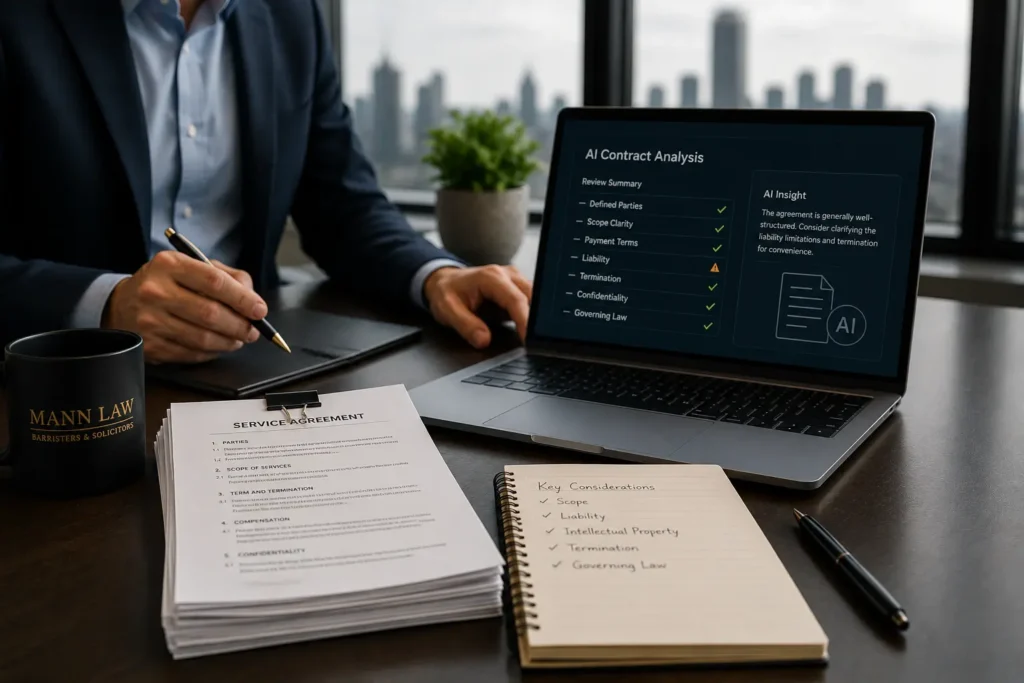
GTA business reviewing an AI-drafted commercial contract with a lawyer.

AI-Generated Contracts: Legal Risks GTA Businesses Should Understand in 2026

AI-Generated Contracts: Legal Risks GTA Businesses Should Understand in 2026 Not Legal Advice This article is general legal information provided by Mann Law and does not constitute legal advice. Reading it does not create a solicitor-client relationship. Every corporate and tax situation is different — speak with a licensed Ontario lawyer and your accountant about your specific circumstances before acting on anything discussed here. Where AI is showing up in contract workflows In 2026, GTA businesses are using generative AI tools across most stages of the contract lifecycle: Drafting first-cut agreements from a plain-language description. Marking up counterparty drafts against an internal playbook. Summarizing long contracts into plain-language briefings for non-legal decision-makers. Extracting key terms — renewal dates, liability caps, indemnity language — from executed contract portfolios. Generating first-cut NDAs, MSAs, statements of work, and vendor terms on demand. Used carefully, these workflows can save time and improve consistency. Used carelessly, they introduce a specific set of legal and operational risks that GTA business owners should understand before AI-generated documents start moving through their organization. Risk 1 — Unreviewed clauses that do not fit the transaction Generative models produce contract language by predicting what usually appears in similar-looking documents. The result is often plausible on its face but does not reflect the specifics of the actual transaction. Common patterns: A limitation-of-liability clause capped at fees paid in the prior 12 months, imported without regard to the actual risk profile of the deal. Indemnity language cross-referencing definitions that do not exist elsewhere in the document. Governing-law and forum clauses that default to a US state when the deal is entirely between Ontario parties. IP-assignment language that assumes an employment relationship when the counterparty is actually a contractor. Termination-for-convenience windows that do not match what was actually negotiated. These are not new problems — cut-and-paste from prior deals produces similar issues. What is different is the pace at which unreviewed language can now be generated and inserted. Without a lawyer-reviewed workflow, this pace outruns the ability of the business to catch mistakes. Risk 2 — Hallucinated legal citations and phantom statutes When AI tools are asked to justify a clause or draft an argumentative provision, they sometimes cite statutes, sections, or cases that do not exist, or that exist but say something different from what the model asserts. This is a well-documented failure mode of generative language models and has led to sanctioned filings in Canadian and US courts over the past two years. In a contract, a fabricated citation is usually less catastrophic than in a court filing, but it still matters: A recital that misstates a statute can be used against the drafter later. A defined term that references a non-existent piece of legislation may be unenforceable. A boilerplate compliance-with-laws clause that references the wrong regulator gives false comfort. Assume that any statute, section number, or case citation appearing in AI-generated contract text has to be checked against a primary source before the document is signed. Risk 3 — Confidentiality, privacy, and third-party model exposure When contract text is submitted to a third-party AI service, several categories of risk arise depending on how the service is configured: Contractual confidentiality obligations. Many contracts contain confidentiality clauses that prohibit disclosure to third parties without consent. Submitting a counterparty’s draft to a public AI service can be a technical breach even if no human ever sees the input. Personal information under PIPEDA. Contracts often contain personal information — names, contact details, sometimes financial details — that is subject to Canadian privacy law. Submitting that content to a third-party service based outside Canada implicates cross-border data-transfer rules and, in some cases, consent obligations. Confidential business information. Pricing, customer lists, and negotiation history embedded in a draft can be exposed if the AI service retains input data or uses it for model improvement. The Office of the Privacy Commissioner of Canada has issued principles for the responsible use of generative AI that address these concerns, including the need for meaningful consent, purpose limitation, and appropriate safeguards on cross-border transfers of personal information. Practically, this means the AI tool your business uses matters. Enterprise-configured tools with data-retention controls, contractual data-processing terms, and Canadian or SOC 2-audited hosting are a different risk profile than a free consumer chatbot. Both may produce useful contract text; only one is safe to feed sensitive material into. Risk 4 — Audit trail and evidentiary questions If a contract is later disputed, courts and arbitrators may ask questions about how the document was produced and who reviewed it. This is not new — the same questions arise with template contracts and drafts produced by junior staff. What is new is the scale of AI-generated language in circulation and the possibility that a party will argue the document was signed without informed human involvement. For GTA businesses that use AI tools in contracting, it is worth building a light-weight audit trail that captures: Which parts of a contract were AI-generated versus human-drafted. Which internal person reviewed the AI output before it was sent to the counterparty. Which lawyer, if any, reviewed the final version. The date and version of the tool used. Risk 5 — Professional-conduct implications when lawyers are in the loop When lawyers use AI tools in contract work, professional-conduct duties still apply. The Law Society of Ontario’s Rules of Professional Conduct require competent representation and confidentiality with respect to client information. Regulators in Canada and internationally continue to emphasize that AI tools do not shift the underlying professional responsibility of the human lawyer. For businesses that engage external counsel, the practical implication is that you should be able to ask your law firm how it uses AI, what safeguards apply to your matter, and how the firm records that AI was used. The Office of the Superintendent of Financial Institutions issued sound-practices guidance for financial-sector AI use in 2026, and while that guidance is directed at federally regulated financial institutions, several of its themes — model risk, human-in-the-loop expectations,

AI-Generated Contracts: Legal Risks GTA Businesses Should Understand in 2026 Read More »