Harry Mann

Is Your Corporation’s Transparency Register Actually Compliant? A 2026 Checklist for Ontario Private Companies

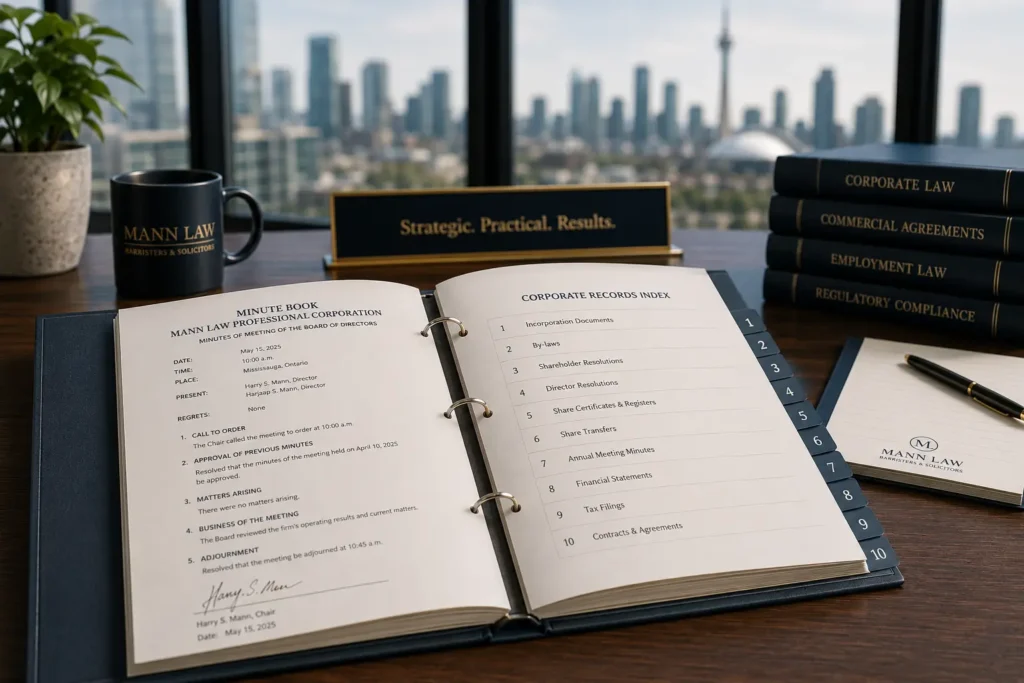
Is Your Corporation’s Transparency Register Actually Compliant? A 2026 Checklist for Ontario Private Companies Not Legal Advice This article is general legal information provided by Mann Law and does not constitute legal advice. Reading it does not create a solicitor-client relationship. Every corporate and tax situation is different — speak with a licensed Ontario lawyer and your accountant about your specific circumstances before acting on anything discussed here. What is a transparency register? A transparency register — sometimes called an ISC register or beneficial-ownership register — is a corporate record that identifies the real human beings who ultimately own or control a corporation. Ontario introduced the requirement for private OBCA corporations effective January 1, 2023 under section 140.2 of the Business Corporations Act (Ontario). Federally incorporated CBCA companies have had a similar register requirement since 2019, and since January 22, 2024 they must also file ISC information with Corporations Canada, portions of which are made publicly searchable. The purpose is to make beneficial ownership visible to law enforcement, tax authorities, and financial regulators, and to reduce the use of Canadian corporations for money laundering, sanctions evasion, and tax avoidance. For a Mississauga business owner, the practical effect is simple: every private corporation you own needs an accurate ISC register, kept up to date, and reviewed at least once a year. Who counts as an individual with significant control? Under OBCA s. 1.1, an individual has significant control (an “ISC”) over a corporation if they hold, directly or indirectly, an interest or right in respect of a significant number of shares, or if they have direct or indirect influence that, if exercised, would result in control in fact. A “significant number of shares” means shares carrying 25% or more of the voting rights, or shares equal to 25% or more of the outstanding shares by fair market value. Two or more people can also be ISCs jointly — for example, when spouses or family members hold shares under an agreement to vote together, or when related persons collectively hold 25% or more. In a typical Mississauga owner-managed business, the ISCs are usually the founders and any family members with 25%-plus holdings. Complications arise when there are family trusts, holding companies stacked above the operating company, shareholder agreements with voting-pool arrangements, or nominee shareholders. Each of these can create ISCs who are not obvious from the share register. What information must the register contain? For each ISC, the OBCA register must include: Name, date of birth, and latest known address. Jurisdiction of residence for tax purposes. The day the individual became — and, if applicable, ceased to be — an ISC. A description of how the individual is an ISC (interests, rights, control). A description of the reasonable steps the corporation took to identify all ISCs and confirm the information. CBCA corporations must record the same categories plus country of citizenship, and must also record an address for service if the individual does not want their residential address made public. The 10-item ISC compliance checklist for 2026 Here is a practical checklist Mississauga owner-managers can walk through with their corporate lawyer before year-end. Confirm whether you are OBCA or CBCA (or both, if you own a group). This determines which rules apply and whether federal filings are also required. Locate your existing ISC register. If your minute book does not contain a separate register — or the register was set up in 2023 and has not been touched since — treat that as a red flag. List every shareholder who holds, directly or indirectly, 25% or more of the shares or votes. Include family trusts, holdcos, and nominee arrangements. For each ISC, confirm you have their full legal name, date of birth, latest known address, and tax-residence jurisdiction on file. Document how each individual meets the ISC test (e.g., “50% direct holder of common shares,” “co-trustee of family trust holding 30% of Class A shares”). Record when each ISC became — or ceased to be — an ISC. If someone came in or exited through a share transfer, freeze, or estate distribution, that date belongs in the register. Document your reasonable-steps process. At least once each fiscal year, the corporation must take reasonable steps to identify all ISCs and confirm the information is accurate. Keep a short memo on file describing what you did. Update within 15 days of learning anything new. The OBCA requires the register be updated within 15 days of the corporation becoming aware of a change. If federally incorporated, confirm your latest ISC filing with Corporations Canada. Filings are due at the same time as the annual return, and within 15 days of any change. Retain records for the required period. The OBCA requires disposal of personal information within one year after the sixth anniversary of the individual ceasing to be an ISC, unless another law requires longer retention. Common gaps we see in Mississauga minute books When we open a minute book to conduct an ISC review — often triggered by a bank refinancing, a new investor coming in, or a preliminary sale discussion — the same handful of gaps show up: The register exists but is out of date. It was set up in 2023 and no reasonable-steps memo has been filed for 2024, 2025, or 2026. Family trusts and holdcos are not traced through. The ISC register lists the holding company as a shareholder but does not identify the individuals behind it, which is not how the ISC rules work. The 25% threshold has been crossed and not recorded. A share issuance, redemption, or family transfer bumped someone across the line and the register was not updated within 15 days. Dates of birth or tax residence are missing. Shareholders were reluctant to share the information when the rules first came in, and the file never got completed. For federal corporations, the annual ISC filing was missed. Corporations Canada annual filings and ISC filings are separate steps in practice, and it is easy to file


Is Your Corporation’s Transparency Register Actually Compliant? A 2026 Checklist for Ontario Private Companies Read More »

Selling Your GTA Business in 2026: Asset Deal or Share Deal After the Capital Gains Reset?

Selling Your GTA Business in 2026: Asset Deal or Share Deal After the Capital Gains Reset? Not Legal Advice This article is general legal information provided by Mann Law and does not constitute legal advice. Reading it does not create a solicitor-client relationship. Every corporate and tax situation is different — speak with a licensed Ontario lawyer and your accountant about your specific circumstances before acting on anything discussed here. Why 2026 is a different planning year If you started thinking about selling your Mississauga or Brampton business in 2023 or 2024, you probably heard from your accountant that the capital gains rules were about to change dramatically. They almost did. Then they did not — and the practical result is that 2026 is a friendlier planning year than most owners expected 24 months ago. Here is the actual state of play as of the current tax year. In April 2024, the federal government proposed increasing the capital gains inclusion rate from one-half to two-thirds on gains above $250,000 for individuals and on all gains for corporations and most trusts. In January 2025, the government deferred the implementation date to January 1, 2026. Then, on March 21, 2025, Prime Minister Mark Carney announced that the proposed increase would be cancelled outright. Budget 2025 reinforced the cancellation. The result: for 2026, the capital gains inclusion rate remains at 50% for individuals, corporations, and trusts. There is no $250,000 threshold and no two-tier system. The Lifetime Capital Gains Exemption (LCGE) — the amount of capital gain from the sale of qualified small business corporation (QSBC) shares that an individual can shelter from tax — was raised to $1,250,000 for dispositions on or after June 25, 2024 and indexation resumed in 2026, bringing the 2026 limit to $1,275,000 per individual. For a couple who both hold qualifying shares, the shelter effectively doubles to roughly $2.55 million of sheltered gain, provided both spouses meet the QSBC tests independently. Meanwhile, on the Ontario side, the provincial government announced nearly $2 million in funding in February 2026 to create Succession Ontario — a first-of-its-kind online hub with tools and resources to help entrepreneurs prepare for ownership transitions. The takeaway from all of this: the tax framework for selling is stable for the moment, the LCGE remains a meaningful shelter, and the Ontario government is signalling that succession planning is a priority. If you have been putting off the decision, 2026 is a reasonable year to start the conversation. Asset sale versus share sale — how the deal is structured When a Canadian small business is sold, the transaction is almost always structured as either an asset sale or a share sale. The choice affects the after-tax proceeds, what liabilities transfer, and how the buyer finances the deal. What is a share sale? In a share sale, the buyer purchases the shares of your corporation. The corporation continues to exist — same tax number, same contracts, same employees, same historical liabilities. Only the ownership changes hands. For the seller, the sale price is treated as a capital gain. If the shares qualify as QSBC shares under the Income Tax Act, up to $1,275,000 of that gain (for 2026) can be sheltered per individual using the LCGE, subject to any prior LCGE use. What is an asset sale? In an asset sale, the buyer purchases specific assets from your corporation — usually the goodwill, customer list, inventory, equipment, and sometimes the real estate — rather than the corporation itself. The seller’s corporation continues to exist and is typically wound up afterwards. For the seller, the proceeds are taxed inside the corporation (as recapture, capital gain, or ordinary income depending on the asset), and then again personally when the after-tax proceeds are distributed as dividends. The LCGE generally cannot be applied to shelter an asset sale directly. The trade-offs at a glance Consideration Share sale Asset sale Typically preferred by Seller Buyer Access to LCGE Yes, if QSBC criteria met Generally no Assumption of liabilities Buyer inherits historical liabilities Buyer selects assets and leaves most liabilities behind Tax on depreciable assets Deferred inside the corporation Recapture triggered on sale Contract assignments Usually not required (corporation continues) Each material contract may need consent Employee transfers Continue with the corporation Deemed termination and re-hire under ESA Real estate transfer tax Not triggered on shares Triggered on real property Deal complexity Simpler on paper, heavier diligence More document-intensive Do your shares actually qualify for the LCGE? The LCGE is a meaningful shelter, but it only applies if your shares meet all three QSBC tests at the time of sale. Some Mississauga business owners assume they qualify and later discover, well into deal negotiations, that they do not. The three tests are: The small business corporation test at the time of sale. At least 90% of the fair market value of the corporation’s assets must be used in an active business carried on primarily in Canada, or be shares/debt of connected small business corporations. The 24-month asset test. Throughout the 24 months immediately before the sale, more than 50% of the fair market value of the corporation’s assets must have been used in an active business. The 24-month holding period test. The shares must have been held by you or a related person throughout the 24 months immediately before the sale. The most common trap is the first test. Corporations that have accumulated retained earnings and parked them in passive investments — GICs, marketable securities, non-operating real estate — can fall below the 90% active-asset threshold. Correcting this typically takes advance planning; it is not something that can be done on the way to closing. The 12- to 24-month pre-sale review list If you are contemplating a sale in the next two years, here is a list of items to consider — most of it in coordination with your corporate lawyer, your accountant, and eventually an M&A advisor. Corporate housekeeping Minute book brought fully current — resolutions, share registers, ISC register, and

Selling Your GTA Business in 2026: Asset Deal or Share Deal After the Capital Gains Reset? Read More »